Buying Land in Nigeria from Abroad: The Complete Legal Verification Guide for Diaspora Investors
Buying land in Nigeria from abroad? Learn the 5 mandatory legal due diligence steps, how to verify land titles, and avoid costly scams. By Nnamdi I. Nwagwu, Esq.

Table of Contents
- 1. Executive Summary
- 2. Can Diaspora Buy Land?
- 3. Nigerian Land Law Framework
- 4. Land Title Documents
- 5. Five Verification Steps
- 6. Power of Attorney & Remote Agency
- 7. Common Fraud Risks
- 8. State Realities: Lagos, Abuja, Imo
- 9. Pre-Disbursement Checklist
- 10. Frequently Asked Questions
- 11. Legal Consultation
1. Executive Summary
For Nigerians residing in the United Kingdom, the United States, Canada, and Europe, purchasing property in Nigeria is a vital milestone. Diaspora remittances actively finance residential homes, commercial developments, and agricultural projects across the federation.
However, remote transactions carry severe structural risks. Distance creates acute information asymmetry. Without independent legal oversight, remote purchasers frequently discover devastating defects after disbursing funds: parcels situated within committed government acquisitions, family representatives diverting capital, or fraudsters selling identical land to multiple buyers using forged title instruments.
Under Nigerian conveyancing law, title is determined strictly by authenticated documentation and statutory registration—never by familial trust, verbal assurances, or receipts. The doctrine of caveat emptor ('let the buyer beware') governs Nigerian real estate. Without independent legal due diligence on the ground, diaspora buyers risk total capital forfeiture. This guide details the governing statutory rules and outlines a proven five-step verification framework to secure transactions safely.
2. Can Diaspora Buy Land?
Does Nigerian Law Permit Non-Resident Citizens to Acquire and Own Real Estate?
Direct Answer: Yes. Section 43 of the 1999 Constitution of the Federal Republic of Nigeria guarantees every citizen the fundamental right to acquire and own immovable property anywhere in Nigeria. Non-residence does not restrict this constitutional entitlement. Diaspora investors can lawfully execute contracts, hold statutory rights of occupancy, and register titles remotely through duly instructed Nigerian legal counsel.
Constitutional Rights and Remote Capacity
Section 43 guarantees that living abroad does not extinguish property rights. A diaspora investor possesses full legal capacity to enter binding contracts of sale, take conveyances, and hold leasehold interests across all thirty-six states and the Federal Capital Territory (FCT).
However, distance creates practical hurdles, precluding personal site inspections and registry checks. To bridge distance safely, Nigerian law permits foreign purchasers to instruct independent legal counsel or grant a formal Power of Attorney. State property legislation dictates conveyancing formalities essential to securing indefeasible title.
3. Nigerian Land Law Framework
To purchase land safely from abroad, diaspora buyers must understand the statutory framework established by the Land Use Act of 1978 (Cap L5, Laws of the Federation of Nigeria 2004), entrenched in the Constitution under Section 315(5)(d).
Radical Title in State Governors (Section 1)
Section 1 of the Land Use Act vests all land within each state in the Governor, held in trust for all citizens. Absolute private ownership does not exist; individuals hold proprietary leasehold interests termed 'Rights of Occupancy.'
Statutory vs. Customary Rights of Occupancy (Sections 5 & 6)
The Act establishes two tenures:
- Statutory Right of Occupancy (Section 5): Granted by the Governor over urban land for terms up to 99 years.
- Customary Right of Occupancy (Section 6): Granted by Local Governments over rural land.
Mandatory Governor's Consent (Section 22) and Nullity (Section 26)
Under Section 22(1), subsequent alienation of a statutory right of occupancy requires prior Governor’s Consent. Under Section 26, unapproved alienations are null and void. In Savannah Bank v. Ajilo (1989) 1 NWLR (Pt. 97) 305, the Supreme Court confirmed consent is mandatory. In Awojugbagbe Light Industries v. Chinukwe (1995) 4 NWLR (Pt. 390) 379, the Court held that executing a deed prior to consent creates an inchoate equitable interest; legal title vests only upon executive consent.
4. Land Title Documents
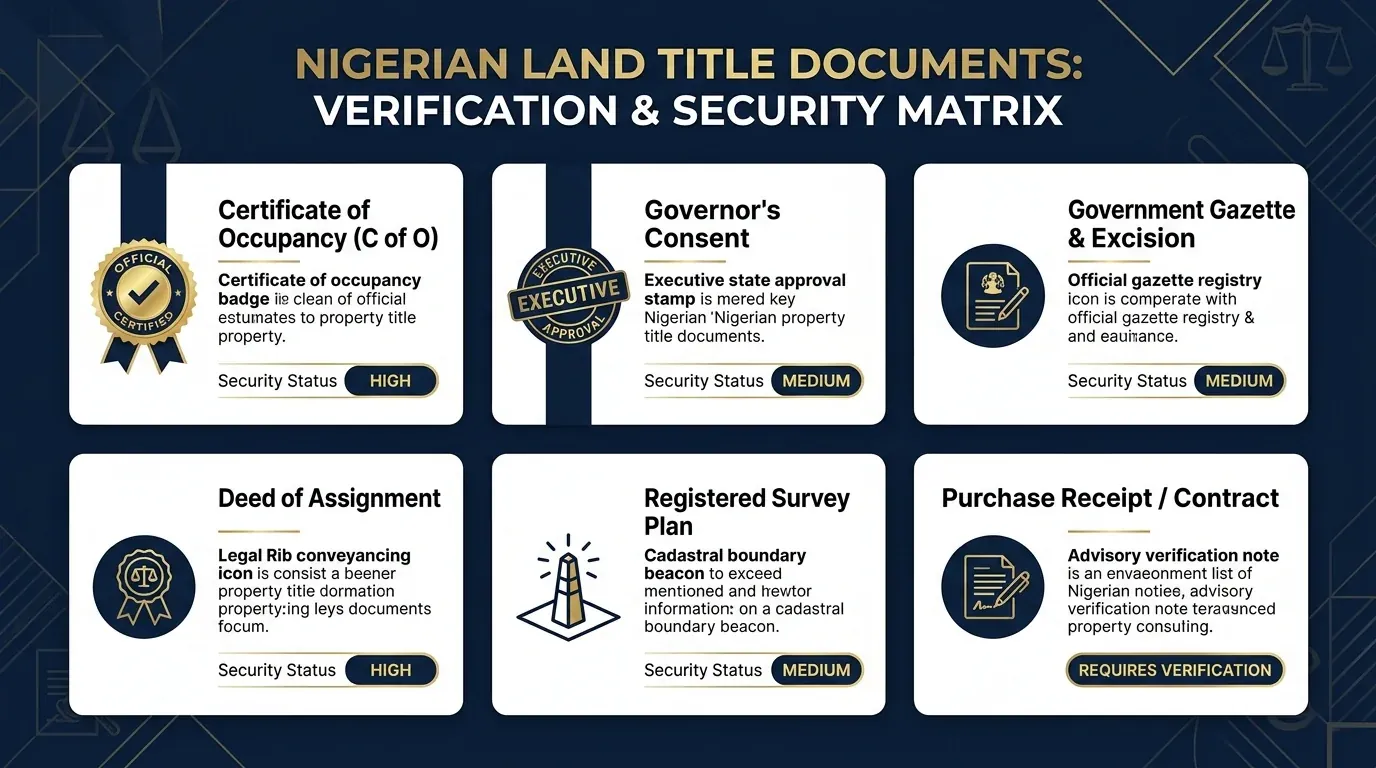
A frequent error among diaspora buyers is treating every property document as proof of ownership. In Nigerian conveyancing, documents serve distinct legal functions: some record payment, others define boundaries, while only authenticated instruments confer marketable title.
Root of Title vs. Mere Evidence of Payment
A root of title demonstrates an unbroken chain of ownership—traditionally at least thirty years, or originating directly from a state grant, an authentic Certificate of Occupancy (C of O), or a gazetted excision. Purchase receipts merely evidence payment and confer zero title. In Idundun v. Okumagba (1976) 9-10 SC 227, the Supreme Court prioritized authenticated title documents among the five methods of proving ownership.
Certificate of Occupancy vs. Governor’s Consent
A C of O is issued by the Governor under Section 9 of the Land Use Act as primary evidence of a statutory grant. It is prima facie rebuttable evidence; courts revoke C of Os granted fraudulently or over committed land. On resale, the Governor issues Governor’s Consent to the Deed of Assignment under Section 22, rather than a second C of O.
Gazette, Excision, and Deed of Assignment
In customary communities, an excision occurs when the state releases acquired land back to the community, published in the State Official Gazette as a valid root of title. The Deed of Assignment transfers the leasehold term, requiring stamping under the Stamp Duties Act and Land Registry registration.
Why a Power of Attorney Is NOT Ownership
In Ude v. Nwara (1993) 2 NWLR (Pt. 278) 638, the Supreme Court held that a Power of Attorney delegates agency; it does not convey title. Ownership requires a registered Deed of Assignment.
| Document Type | Legal Function | Confers Title? | Governing Authority |
|---|---|---|---|
| Certificate of Occupancy (C of O) | 99-year statutory grant | Yes (prima facie) | State Governor (Sec 9, Land Use Act) |
| Governor's Consent | Validates resale or transfer | Yes (perfects title) | State Governor (Sec 22, Land Use Act) |
| Official Gazette / Excision | Official community release | Yes (valid root) | State Government Official Gazette |
| Deed of Assignment | Transfers leasehold interest | Yes (when registered) | Land Registry / Stamp Duties Act |
| Registered Survey Plan | Geospatial boundary map | No (boundary only) | State Surveyor-General |
| Purchase Receipt | Acknowledges payment | No (payment record) | Vendor / family agreement |
| Power of Attorney | Delegates agency authority | No (Ude v. Nwara) | Donor executed; Notary/Consular |
5. Five Verification Steps
To safeguard investments when buying land from abroad, diaspora buyers must enforce a five-step legal verification framework:
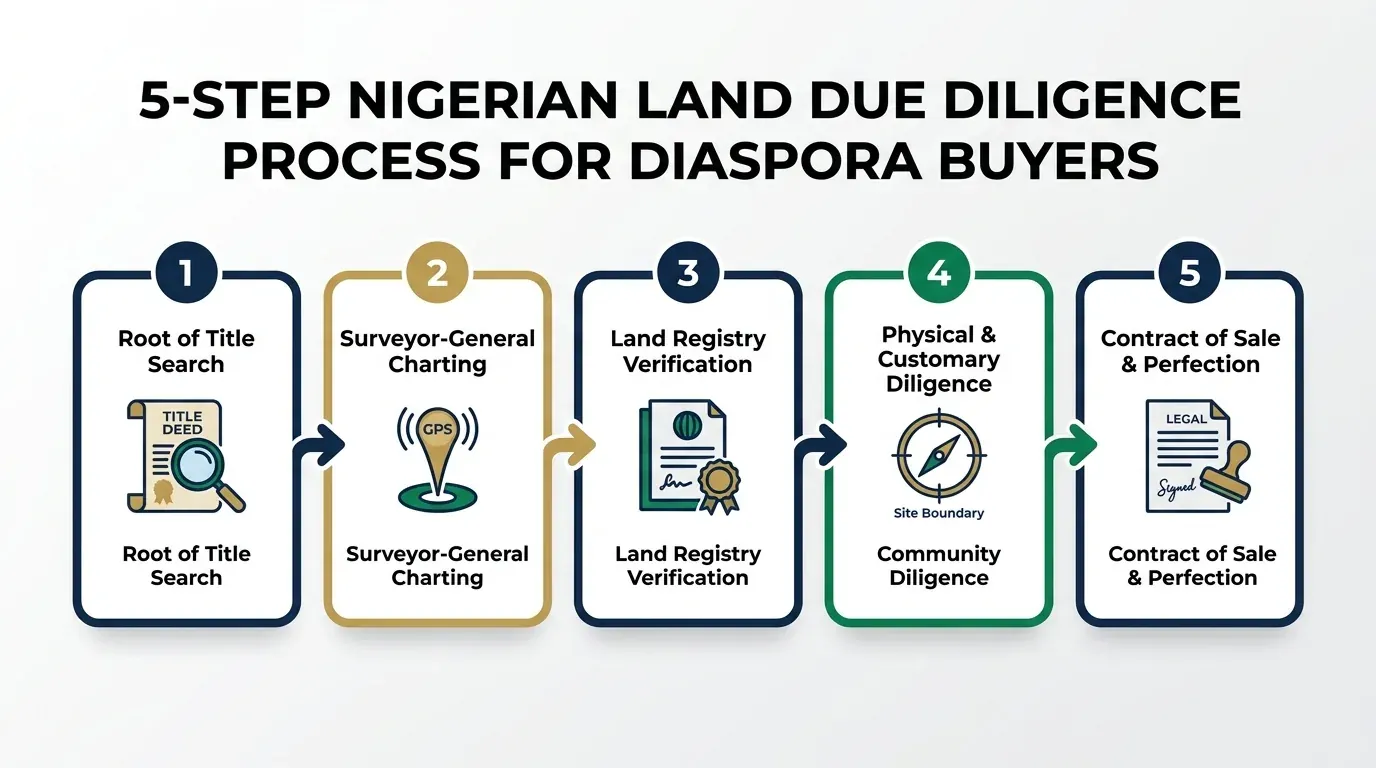
Step 1: Root of Title and Vendor Verification
Counsel independently verifies vendor identity and capacity:
- Individual Vendors: Inspect original deeds and national identification to confirm registered ownership.
- Deceased Estate Property: Where land belonged to a deceased owner, vendors must produce a valid Grant of Probate or Letters of Administration from the High Court. Sales by heirs without probate are void.
- Corporate Developers: Counsel conducts searches at the Corporate Affairs Commission (CAC) under CAMA 2020 to verify incorporation, directors, and board authority.
Step 2: Survey Plan, Coordinates, and Acquisition Checks
Before registry visits, counsel coordinates geospatial verification:
- Coordinate Picking: An independent registered surveyor records boundary beacon coordinates via GPS.
- Survey Charting at Surveyor-General's Office: Coordinates are charted against official composite maps to confirm the parcel is free from acquisition, under uncommitted acquisition (regularizable), or within committed government acquisition (infrastructure corridors). Committed land cannot be regularized; structures face demolition without compensation.
Step 3: Land Registry Searches
Counsel conducts formal searches at the State Land Registry (e.g., Alausa in Lagos, AGIS in Abuja, or Ministry of Lands in Owerri) to verify registered ownership and confirm freedom from mortgages, court attachments, caveats, or lis pendens (litigation).
Step 4: Physical Inspection and Customary Investigation
Physical due diligence uncovers critical facts absent from official registers:
- Verify physical beacons match survey coordinates and confirm zero boundary encroachments.
- For community land, apply Ajuwon v. Akanni (1993) 9 NWLR (Pt. 316) 182: sale without Family Head consent is void ab initio; sale without principal members' consent is voidable. Counsel checks family consensus and Omo-Onile disputes.
Step 5: Contract of Sale, Staged Payment, and Perfection
Never pay the purchase price upon verbal agreement:
- Contract of Sale: Executed first, specifying purchase price, deposit terms, conditions precedent, and completion timelines.
- Staged Payments: Disburse earnest deposit into escrow; disburse balance only upon surrender of original deeds and vacant possession.
- Deed of Assignment: Drafted by buyer's counsel with comprehensive title warranties, indemnity covenants, and registration formalities.
6. Power of Attorney & Remote Agency
Because diaspora buyers cannot attend closings physically, delegating authority is standard. However, informal reliance on family members is the primary driver of diaspora property disputes. Relatives often lack legal expertise, fall victim to syndicates, or register titles in their own names.
Structuring a Valid Power of Attorney
To protect remote interests, buyers should execute a formal Power of Attorney appointing an independent legal practitioner:
- Specific Powers: Authorize counsel to execute searches, sign sale contracts, receive deeds, and lodge documents for registration.
- Attestation Abroad: Under Section 150 of the Evidence Act 2011, a Power of Attorney executed outside Nigeria enjoys a statutory presumption of due execution if authenticated by a Notary Public or attested at a Nigerian High Commission or Embassy.
- Separate Perfected Conveyance: The Power of Attorney establishes agency only. Full legal ownership requires a perfected Deed of Assignment in the buyer's personal name.
7. Common Fraud Risks
Understanding documented fraud schemes allows diaspora investors to avoid catastrophic losses:
- Purchasing in Committed Government Acquisitions: Syndicates clear vegetation and sell plots within planned public infrastructure corridors. Under Section 28 of the Land Use Act, state authorities can demolish structures without compensation.
- Multiple Sales of Identical Parcels: Unscrupulous vendors issue identical layout receipts to multiple buyers. Under Nigerian priority rules, the first registered interest prevails.
- Informal Cash Transactions: Disbursing funds into personal accounts without written contracts of sale prevents legal recovery if title fails.
- Forged and Cloned Title Documents: Scammers fabricate cloned conveyance deeds, counterfeit C of O stamps, or stolen registry file numbers. Only an official Land Registry search detects forged instruments.
- Relying on Vendor's Lawyer: Sellers frequently offer to 'handle paperwork' through their own attorney. An attorney representing a vendor cannot protect the purchaser's legal interests.
8. State Realities: Lagos, Abuja, and Imo State
Land administration is decentralized across Nigeria, requiring localized legal strategies:
- Lagos State: The most commercialized property market, regulated by the Lands Registration Law of Lagos State 2015. Given severe land pressure in Ibeju-Lekki and Epe, coordinate charting at Alausa is critical. Private developers must be registered under the Lagos State Real Estate Regulatory Authority (LASRERA) Law 2022.
- Abuja (Federal Capital Territory): Administered directly by the Federal Government under Section 297(2) of the 1999 Constitution through the Federal Capital Development Authority (FCDA). Searches and consent occur at the Abuja Geographic Information Systems (AGIS). Buyers must strictly verify compliance with the Abuja Master Plan.
- Imo State & South-Eastern Nigeria: Governed by state ministries of lands (such as the Ministry of Lands, Survey and Physical Planning in Owerri). Customary and communal land holdings dominate, making thorough investigation of family roots of title and community leadership mandatory.
9. Pre-Disbursement Checklist
Before authorizing final disbursement, diaspora buyers and their counsel must verify this strict pre-disbursement checklist:
- Survey Charting Confirmed: Official written charting from the Surveyor-General confirms the parcel is free from committed government acquisition.
- Registry Search Completed: Search report verifies vendor title and confirms zero registered mortgages, caveats, or court attachments.
- Probate or CAC Authority Verified: High Court Letters of Administration or CAC searches confirm vendor legal capacity to sell.
- Boundary Coordinates Re-Verified: Independent physical beacon inspection confirms zero encroachments and verified vacant possession.
- Contract of Sale Executed: Written contract signed by all parties, detailing warranties, indemnities, and staged disbursement terms.
- Original Deeds Surrendered: Original title deeds, prior conveyances, and survey plans handed over to buyer's counsel before final funds release.
10. Frequently Asked Questions
Can a Nigerian living abroad legally buy land in Nigeria without travelling home?
Direct Answer: Yes. Diaspora investors can legally acquire land without travelling home by appointing an independent legal practitioner via a formal Power of Attorney. Counsel conducts searches, reviews contracts, and oversees title perfection under Section 43 of the 1999 Constitution.
Does a purchase receipt and survey plan prove land ownership in Nigeria?
Direct Answer: No. Under Nigerian law, a receipt only proves payment and a survey plan only demarcates boundaries. Neither confers title. Ownership requires a valid root of title transferred via an executed, stamped, and registered Deed of Assignment.
What is the difference between a Certificate of Occupancy (C of O) and Governor’s Consent?
Direct Answer: A C of O is the initial 99-year statutory lease granted by a Governor under Section 9 of the Land Use Act. Governor's Consent is the mandatory approval required under Section 22 whenever that property is subsequently sold or assigned.
Why is a Power of Attorney not a title document in Nigeria?
Direct Answer: Under Ude v. Nwara (1993), the Supreme Court held that a Power of Attorney delegates agency; it does not transfer title. Conveying legal ownership requires an executed, stamped, and registered Deed of Assignment.
What happens if I buy land that is under committed government acquisition?
Direct Answer: Land under committed acquisition is designated for public infrastructure. Private title cannot be regularized. Structures built on such land face demolition without statutory compensation under Section 28 of the Land Use Act.
11. Legal Consultation
Acquiring land in Nigeria from abroad should be an empowering milestone that builds generational wealth, not an ordeal of disputed boundaries or diverted remittances. Retaining qualified, independent legal counsel on the ground before committing capital guarantees peace of mind and protects your investment.
Retain Independent Legal Counsel for Your Property Due Diligence
At Chukwunyere Law Chambers, Nnamdi Igwebuike Nwagwu, Esq. provides legal advisory and property due diligence for diaspora investors across the UK, US, Canada, and Europe. With over twenty-one years of legal practice, our chambers delivers:
- Land Registry searches across Lagos, Abuja (AGIS), Imo State, and South-Eastern Nigeria.
- Independent coordinate charting and government acquisition verification.
- Family and customary title investigations.
- Contract of Sale drafting, Power of Attorney attestation, and Deed of Assignment perfection.
Contact Chambers Directly:
- WhatsApp Consultation: +234 707 015 7195
- Chambers Contact Page: Schedule Consultation
- Office Chambers: 82/84 Wetheral Road, Owerri, Imo State, Nigeria (consultations nationwide and virtually).
Legal Information Disclaimer:
The information in this article is provided solely for educational purposes under Nigerian law. It does not constitute formal legal advice, nor does reading it establish an attorney-client relationship. Readers must retain a qualified Nigerian legal practitioner to conduct site-specific investigations before disbursing purchase funds.
Barrister & Solicitor
Associate at Chukwunyere Law Chambers, providing corporate, property, and civil litigation legal advisory in Nigeria.