Can INEC Be Sued for Failing to Protect the Integrity of Nigeria's Electoral Process?
Can a Nigerian citizen sue INEC for electoral misconduct or compromised polls? Discover locus standi rules, court precedents, and legal remedies. By Nnamdi I. Nwagwu, Esq.

Table of Contents
- Direct Answer: Can a Citizen Sue INEC?
- 1. Introduction: Sovereignty, Elections & Institutional Accountability
- 2. Constitutional Status & Operational Independence of INEC
- 3. Can an Ordinary Citizen Sue INEC? The Question of Locus Standi
- 4. A Pivotal Judicial Development: Dr. Ephraim Okoye v. INEC
- 5. Supreme Court Jurisprudence: Adesanya to Public Interest Litigation
- 6. Does INEC's Legal Personality Allow It to Be Sued? (Electoral Act 2022)
- 7. Can a Citizen Approach the Court Before an Election? (Section 285)
- 8. Can a Citizen Sue INEC After an Election? The Section 130 Boundary
- 9. What Reliefs and Remedies Can a Citizen Seek Against INEC?
- 10. The Role of Public-Interest Litigation in Protecting Democracy
- 11. Conclusion: Towards Citizen-Led Electoral Accountability
- 12. Frequently Asked Questions (FAQ)
- 13. Legal Consultation & Chambers Contact
Direct Answer: Can a Nigerian Citizen Sue INEC?
Yes. An ordinary Nigerian citizen can sue the Independent National Electoral Commission (INEC). Under Section 1(1) of the Electoral Act 2022, INEC is a body corporate with perpetual succession that can sue and be sued in its corporate name. Unlike the President or Governors under Section 308 of the 1999 Constitution, INEC and its commissioners possess no constitutional immunity.
However, a citizen must establish locus standi (legal standing) and a justiciable cause of action, such as unlawful voter disenfranchisement, refusal to issue Permanent Voter Cards (PVCs), or polling-unit administrative manipulations directly compromising their vote (as affirmed in Dr. Ephraim Okoye v. INEC). Crucially, ordinary citizens cannot use regular civil courts to void or overturn general election results, which is reserved exclusively for election tribunals under Section 130(1) of the Electoral Act 2022.
1. Introduction: Sovereignty, Elections & Institutional Accountability
Democracy is founded upon the constitutional sovereignty of the people. Under Section 14(2)(a) of the Constitution of the Federal Republic of Nigeria 1999 (as amended), sovereignty belongs to the people of Nigeria, from whom government derives all its powers and authority. In a constitutional democracy, sovereign power does not belong to political parties, incumbent political office holders, or electoral management institutions—it belongs exclusively to the electorate.
Elections provide the indispensable constitutional mechanism through which citizens exercise that sovereignty by choosing their representatives. Consequently, where the electoral process is compromised, manipulated, unlawfully administered, or conducted in flagrant disregard of statutory rules and guidelines, the resulting injury extends far beyond unsuccessful political candidates. It directly injures the electorate, strikes at the root of democratic institutions, and undermines the constitutional legitimacy of government itself.
In Nigeria, the Independent National Electoral Commission (INEC) occupies a central position in the administration of elections. It is constitutionally established as an independent electoral body entrusted with organizing, undertaking, and supervising elections into designated public offices across the Federation.
Yet, an urgent constitutional question continues to confront Nigerian jurisprudence:
- Where INEC fails, neglects, or refuses to discharge its constitutional and statutory responsibilities in protecting the integrity of an election, can an ordinary Nigerian citizen approach a court of law to compel accountability?
- Must a citizen necessarily be a nominated political candidate or a registered political party before challenging an unlawful act, omission, or administrative failure of INEC?
- Does the constitutional independence of INEC place it beyond judicial scrutiny?
These questions deserve rigorous legal examination. The answer under Nigerian law is definitive: INEC is not above the law, and its constitutional independence does not confer immunity from judicial proceedings. However, the right of an individual citizen to sue must be carefully balanced against the established principles of locus standi and the specialized constitutional procedures governing election petitions.
2. Constitutional Status & Operational Independence of INEC
The Independent National Electoral Commission is established under Section 153(1)(f) of the Constitution of the Federal Republic of Nigeria 1999 (as amended). Its specific powers and operational mandate are set out in Part I of the Third Schedule to the Constitution.
Paragraph 15 of Part I of the Third Schedule outlines the Commission's responsibilities, which include:
- Organising, undertaking, and supervising elections to the offices of the President and Vice-President, Governor and Deputy Governor, and membership of the Senate, House of Representatives, and State Houses of Assembly;
- Registering political parties in accordance with the Constitution and applicable statutes;
- Monitoring the organisation and operation of political parties, including their finances, conventions, congresses, and party primaries;
- Arranging and conducting the continuous registration of eligible voters;
- Preparing, maintaining, and revising the national register of voters;
- Monitoring political campaigns and providing regulations governing political parties; and
- Conducting civic voter education and promoting sound democratic processes.
These responsibilities demonstrate that INEC is not a routine administrative bureau; it is a permanent constitutional institution entrusted with safeguarding the democratic choices of over 200 million Nigerians.
Constitutional Independence vs. Constitutional Immunity
Section 158(1) of the 1999 Constitution guarantees the independence of the Commission by providing that, in exercising its power to make appointments or exercise disciplinary control over persons, it:
"shall not be subject to the direction or control of any other authority or person."
However, in Nigerian jurisprudence, constitutional independence must never be confused with constitutional immunity.
The constitutional framework makes this distinction unmistakable. Under Section 308 of the 1999 Constitution, absolute immunity from civil and criminal proceedings is strictly confined to four designated executive offices: the President, Vice-President, State Governors, and Deputy Governors. No constitutional or statutory immunity is extended to INEC, its National Chairman, National Commissioners, or Resident Electoral Commissioners (RECs).
The independence of INEC is designed to insulate it from executive coercion and partisan political pressure—not to exempt it from the rule of law or place its administrative actions beyond the supervisory jurisdiction of the judiciary. Under Section 6(6)(b) of the Constitution, the judicial powers of the courts:
"shall extend to all matters between persons, or between government or authority and to any person in Nigeria, and to all actions and proceedings relating thereto, for the determination of any question as to the civil rights and obligations of that person."
Therefore, while INEC may be independent in executing its constitutional mandate, it is not independent of the Constitution itself.
3. Can an Ordinary Citizen Sue INEC? The Question of Locus Standi
This is the central procedural battleground in public law litigation against electoral bodies.
The starting point is the fundamental legal doctrine of locus standi (legal capacity to institute proceedings). Generally, a litigant approaching the court must demonstrate a sufficient legal interest in the subject matter of the proceedings and show that their civil rights and obligations have been directly affected, or that they have sustained an injury over and above that suffered by the general public.
Traditionally, respondents in election disputes have argued that electoral integrity is strictly an issue between political parties and their candidates. Under this restrictive doctrine, ordinary voters are treated as mere onlookers without legally enforceable rights once balloting concludes.
However, a modern constitutional perspective recognizes that an eligible Nigerian citizen who is a registered voter and participated in an election possesses a legally cognisable interest in ensuring that their vote is properly recorded, counted, collated, and reflected in the declared results. The franchise is a constitutional entitlement. Electoral integrity is not the private commercial property of political candidates; it is a vital public interest touching the democratic franchise of every citizen.
Nonetheless, Nigerian superior courts maintain a strict distinction between:
- A citizen demonstrating a direct, personalized electoral grievance: such as unlawful exclusion from voter registration, refusal to issue a PVC, or demonstrable manipulation of the specific polling unit where the citizen cast their ballot; and
- A citizen asserting a generalized public complaint: founded merely on ideological disagreement or broad dissatisfaction with the national outcome of an election.
4. A Pivotal Judicial Development: Dr. Ephraim Okoye v. INEC
An important judicial milestone concerning voter standing occurred on May 4, 2026, when the High Court of the Federal Capital Territory (FCT), sitting in Maitama, Abuja, delivered a landmark ruling in Suit No: CV/2910/2023: Dr. Ephraim Okoye v. Independent National Electoral Commission (INEC).
Facts of the Case
The claimant, Dr. Ephraim Okoye, an eligible voter who cast his ballot at Polling Unit 003, Finance Quarters 1, Wuye, Abuja, during the February 25, 2023 Presidential Election, approached the FCT High Court. He alleged that INEC failed to conduct the poll at his polling unit in accordance with its mandatory statutory guidelines and regulations. Specifically, he complained about the alleged alteration and falsification of his polling unit result on the IReV portal, which contradicted the physical Form EC8A issued at the polling center. He claimed declaratory reliefs, mandatory orders for correction, and general damages for the unlawful compromise of his franchise.
INEC's Preliminary Objection
INEC filed a preliminary objection challenging the competence of the suit and the jurisdiction of the court. The Commission argued that:
- The claimant was neither a political party nor a candidate and therefore lacked the requisite locus standi to institute proceedings regarding election conduct; and
- The High Court lacked jurisdiction because any matter touching upon presidential election results could only be questioned before the Presidential Election Petition Tribunal.
The Ruling of Justice Peter Kekemeke
On May 4, 2026, Hon. Justice Peter Kekemeke dismissed INEC's preliminary objection in its entirety, delivering a ruling of profound importance for democratic accountability:
- The court held that a registered voter who participated in an election and has a genuine complaint about statutory breaches committed by INEC at his polling unit possesses sufficient legal interest to seek judicial accountability.
- The court reasoned that a citizen who braves the queues to cast his vote cannot be treated as a meddlesome interloper when seeking to ensure that the electoral commission obeys its own statutory rules.
- The court affirmed that citizens have a direct, legally protectable interest in the sanctity of the electoral system.
Essential Legal Note: While Dr. Ephraim Okoye v. INEC is a notable judicial precedent, it was a ruling on a preliminary objection delivered by a State High Court, not a final determination of the substantive merits or a binding Supreme Court judgment. It establishes persuasive authority that voters have standing to challenge administrative breaches, but it does not grant unrestricted licence to challenge overall election declarations outside election tribunals.
5. Supreme Court Jurisprudence: Adesanya to Public Interest Litigation
The general principles governing locus standi in Nigeria are anchored on binding Supreme Court authorities.
The Restrictive Threshold: Adesanya v. President FRN (1981)
In the foundational case of Senator Abraham Adesanya v. President of the Federal Republic of Nigeria (1981) 5 SC 112 (also reported in (1981) 2 NCLR 358), the Supreme Court held that Section 6(6)(b) of the Constitution requires a plaintiff to demonstrate that their personal civil rights and obligations have suffered an injury beyond that of the general public before invoking judicial intervention. Under a strict application of Adesanya, broad complaints about electoral failures shared equally by all citizens are non-justiciable.
Capacity to Sue vs. Substantive Merits: INEC v. Ogbadibo Local Government (2015)
A vital distinction was established by the Supreme Court in INEC v. Ogbadibo Local Government & Ors (2015) LPELR-24839(SC). The apex court ruled that:
- A claimant's capacity to institute an action is entirely distinct from whether the claimant will ultimately succeed on the merits.
- If the statement of claim discloses an arguable legal right and a demonstrable statutory breach, the court must assume jurisdiction to hear the case, rather than dismissing it prematurely at the threshold.
The Modern Relaxation: COPW v. NNPC (2019)
Modern Nigerian jurisprudence has progressively relaxed the rigid strictures of Adesanya. In Centre for Oil Pollution Watch (COPW) v. Nigerian National Petroleum Corporation (NNPC) (2019) 5 NWLR (Pt. 1666) 518, the Supreme Court unanimously held that narrow interpretations of locus standi must not be permitted to shield public statutory bodies from accountability when they breach statutory obligations owed to the public.
6. Does INEC's Legal Personality Allow It to Be Sued? (Electoral Act 2022)
Beyond standing, does the law confer suable legal personality on INEC?
The answer is explicitly provided in Section 1(1) of the Electoral Act 2022 (as amended):
"The Independent National Electoral Commission as established by section 153 of the Constitution (in this Act referred to as 'the Commission')—
(a) is a body corporate with perpetual succession; and
(b) may sue and be sued in its corporate name."
This statutory provision definitively confirms that INEC enjoys no civil immunity. It is a corporate juristic person capable of being brought before the courts for breaches of statutory, constitutional, or administrative obligations.
Circumstances Justifying Legal Proceedings by Citizens
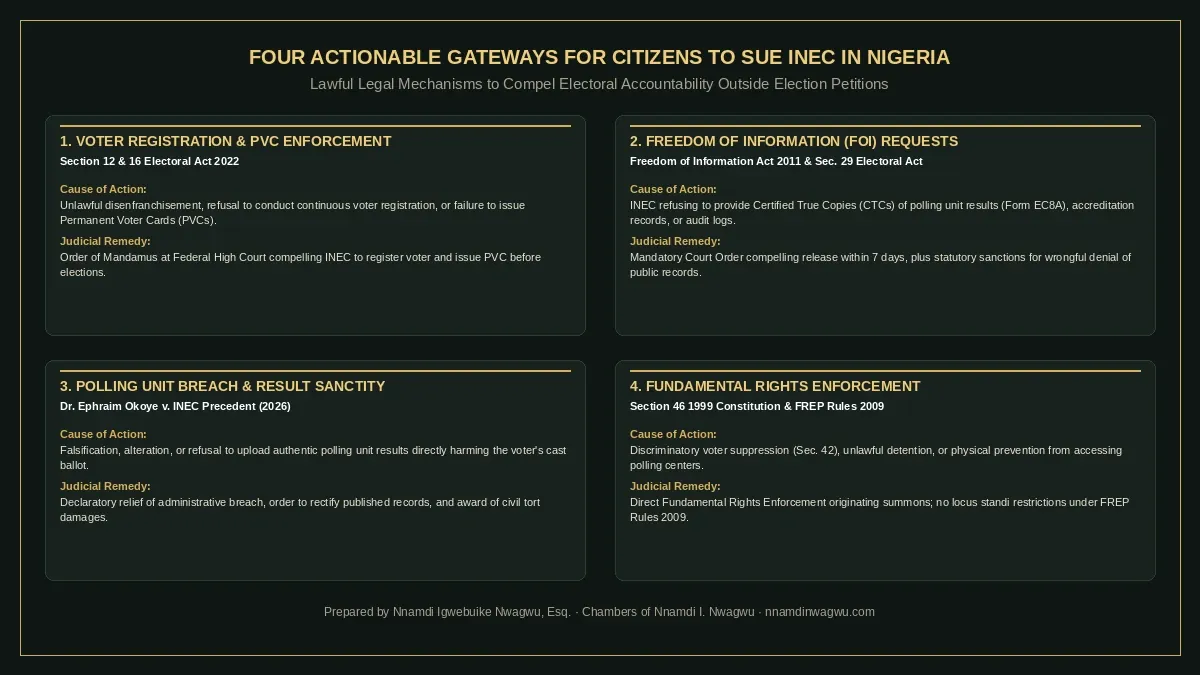
A citizen demonstrating sufficient legal standing may initiate civil proceedings against INEC under several recognized circumstances:
| Actionable Scenario | Statutory / Constitutional Basis | Available Judicial Remedy |
|---|---|---|
| Unlawful Voter Disenfranchisement | Sections 12 & 16, Electoral Act 2022; Section 42 of the 1999 Constitution | Order of Mandamus compelling voter registration and issuance of PVC |
| Wrongful Denial of Public Documents | Freedom of Information (FOI) Act 2011; Section 29, Electoral Act 2022 | Mandatory injunction compelling release of Certified True Copies (CTCs) of Form EC8A |
| Polling Unit Breach & Result Alteration | Sections 60 & 64, Electoral Act 2022 (Okoye v. INEC precedent) | Declaratory relief of administrative breach, rectification of records, civil damages |
| Fundamental Rights Infringement | Section 46, 1999 Constitution; FREP Rules 2009 | Injunctions restraining discriminatory suppression and compensation for civil rights breach |
It is critical to note: A plaintiff cannot merely assert that 'INEC failed Nigeria.' The pleadings must disclose specific, verifiable facts demonstrating an actionable breach of a legal duty directly affecting the claimant.
7. Can a Citizen Approach the Court Before an Election? (Section 285)
A citizen may wish to challenge an action, guideline, or omission of INEC before balloting commences. However, the constitutional framework governing pre-election matters imposes strict procedural limitations.
Under Section 285(14) of the 1999 Constitution (as amended by the Fourth Alteration Act No. 21 of 2017), pre-election matters are narrowly defined and restricted to:
- Section 285(14)(a): Suits by an aspirant challenging the conduct of party primaries or candidate nomination;
- Section 285(14)(b): Suits by an aspirant challenging INEC's actions or decisions concerning candidate schedules or participation; and
- Section 285(14)(c): Suits by a registered political party challenging INEC's refusal to accept its nominated candidates.
Ordinary citizens and civil society groups do not possess standing to institute pre-election suits under Section 285(14) to challenge political party candidates (see PDP v. Sylva (2012) 13 NWLR (Pt. 1316) 85).
However, where a citizen's complaint falls outside candidate nomination—such as INEC unlawfully terminating continuous voter registration or refusing to distribute PVCs—the citizen is not bound by Section 285(14). The citizen may invoke the general civil jurisdiction of the Federal High Court under Section 251(1) of the Constitution via an originating application for judicial review or enforcement of statutory duty.
8. Can a Citizen Sue INEC After an Election? The Section 130 Boundary
This marks the most critical legal boundary in Nigerian electoral law.
Under Section 130(1) of the Electoral Act 2022:
"No election and return at an election under this Act shall be questioned in any manner other than by a petition complaining of an undue election or undue return (in this Act referred to as an 'election petition') presented to the competent tribunal or court in accordance with the provisions of the Constitution or of this Act, and in which the person elected or returned is joined as a party."
Furthermore, under Section 133(1) of the Electoral Act 2022, only two classes of litigants possess standing to present an election petition:
- A candidate at the election; or
- A political party which participated in the election.
Ordinary citizens do not have standing to present an election petition.
Consequently, where the substance of a citizen's complaint is that an election result was rigged, that votes were improperly counted across a constituency, or that a declared winner should be unseated, the regular High Court has zero subject-matter jurisdiction. Any civil suit filed by a citizen seeking to void or overturn an announced election outcome will be promptly dismissed for want of jurisdiction.
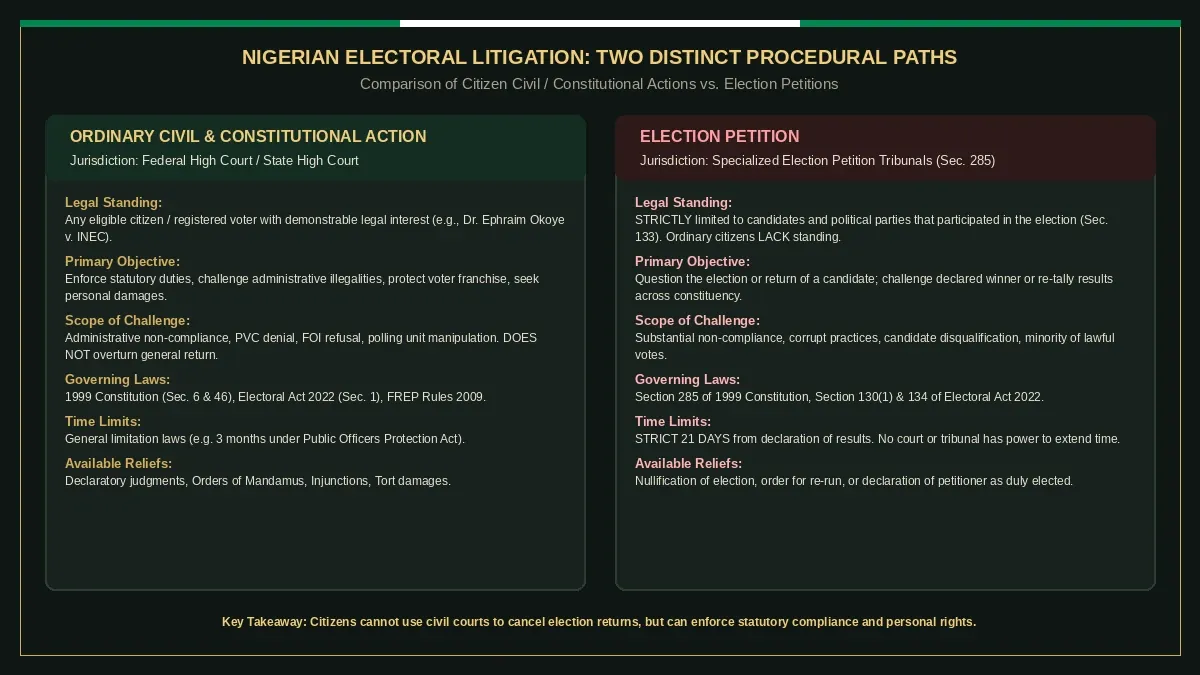
Comparison: Civil Actions vs. Election Petitions
| Legal Dimension | Ordinary Civil / Administrative Action | Election Petition |
|---|---|---|
| Primary Objective | Enforce statutory duties, challenge administrative illegalities, claim tort damages | Question the return or validity of declared election results across a constituency |
| Judicial Forum | Federal High Court / State High Court / FCT High Court | Specialized Election Petition Tribunal (or Court of Appeal for Presidential) |
| Standing (Locus Standi) | Eligible registered voter demonstrating personal legal injury (Okoye v. INEC) | Strictly limited to candidates and participating political parties (Sec. 133) |
| Limitation Period | General limitation laws (e.g. 3 months under Public Officers Protection Act) | Strict 21 days from declaration of results (Sec. 134, Electoral Act) |
| Available Reliefs | Declaratory judgments, Orders of Mandamus, Injunctions, Damages | Nullification of election, order for re-run, or return of candidate |
The narrow post-election exception recognized in Dr. Ephraim Okoye v. INEC applies only where:
- The suit does not question the final return or seek to invalidate the declared winner's title;
- The complaint addresses a distinct, independent administrative breach committed by INEC at the plaintiff's polling unit; and
- The reliefs sought are strictly confined to declaratory pronouncements, correcting records, or awarding personal tort damages for the violation of the voter's franchise.
9. What Reliefs and Remedies Can a Citizen Seek Against INEC?
Where a citizen establishes locus standi and proves a justiciable wrong, Nigerian superior courts possess broad powers under Section 6 of the 1999 Constitution to grant appropriate judicial remedies:
- Declaratory Reliefs: A formal judicial pronouncement that a specific administrative action, regulation, or omission of INEC is unconstitutional, ultra vires, or in violation of the Electoral Act 2022.
- Mandatory Orders (Order of Mandamus): An order compelling INEC to perform a mandatory statutory duty that it has unlawfully neglected or refused to perform (e.g., issuing PVCs or releasing public records).
- Prohibitory & Injunctive Orders: An equitable remedy restraining the Commission, its servants, or agents from implementing an unlawful administrative policy or proceeding with flawed registration lists.
- Fundamental Rights Enforcement Orders: Injunctions and restorative orders under Section 46 of the Constitution and the FREP Rules 2009 for civil rights violations.
- Civil Tort Damages: Compensation for direct financial injury or demonstrable violation of civil rights resulting from unlawful administrative conduct. Damages are not automatic; specific injury must be pleaded and proved with cogent evidence.
10. The Role of Public-Interest Litigation in Protecting Democracy
Public-interest litigation (PIL) is an essential constitutional instrument for holding public statutory bodies accountable. Its objective is not personal commercial profit, but ensuring that public institutions operate within the four corners of the law.
In a constitutional democracy, electoral integrity cannot be left entirely to political parties and candidates. Political actors frequently compromise or withdraw disputes based on partisan calculations. It is the ordinary citizen who bears the long-term consequences of compromised democratic institutions.
The courts must continually balance two imperatives:
- Preventing frivolous, speculative, or politically motivated litigation designed to paralyze election administration; and
- Ensuring that genuine grievances regarding unlawful conduct by electoral bodies receive proper judicial scrutiny on the merits.
11. Conclusion: Towards Citizen-Led Electoral Accountability
The question of whether an ordinary Nigerian citizen can sue INEC raises fundamental constitutional principles.
The legal position is clear: INEC is a suable statutory and constitutional body, and its independence does not place it beyond the jurisdiction of the courts. Under Section 1(1) of the Electoral Act 2022, INEC may sue and be sued in its corporate name.
A citizen who establishes sufficient legal interest, demonstrates a justiciable cause of action, and complies with procedural rules may maintain proceedings against the Commission. However, this right must be strictly distinguished from post-election challenges to declared returns, which belong exclusively to election tribunals under Section 130(1) of the Electoral Act.
Democracy does not end at the polling station. It demands institutional vigilance, transparency, and the fearless enforcement of the law. The right to vote must be accompanied by the right to demand that the vote is lawfully protected.
12. Frequently Asked Questions (FAQ)
Can an ordinary Nigerian citizen sue INEC to cancel a presidential or governorship election result?
No. Under Section 130(1) and Section 133(1) of the Electoral Act 2022, any action questioning the election or return of a candidate can only be instituted by an election petition before a specialized Election Petition Tribunal. Ordinary citizens do not possess standing to file election petitions; that right is strictly confined to candidates and participating political parties.
Does the Chairman of INEC or Resident Electoral Commissioners enjoy constitutional immunity?
No. Constitutional immunity under Section 308 of the 1999 Constitution applies exclusively to four offices: the President, Vice-President, State Governors, and Deputy Governors. The INEC Chairman, National Commissioners, and RECs have no constitutional immunity and can be sued in their official or corporate capacities.
What is the significance of the ruling in Dr. Ephraim Okoye v. INEC?
In Dr. Ephraim Okoye v. INEC (Suit No: CV/2910/2023), the FCT High Court ruled on May 4, 2026, that an accredited voter who cast his ballot has the legal standing (locus standi) to sue INEC for alleged failures in conducting the poll and collating authentic results at his specific polling unit. It established persuasive precedent that electoral accountability is not the exclusive preserve of politicians.
How can a citizen access polling unit records or certified documents from INEC?
Under Section 29 of the Electoral Act 2022 and the Freedom of Information (FOI) Act 2011, any citizen has the legal right to apply to INEC for Certified True Copies (CTCs) of public electoral documents, including polling unit results (Form EC8A). If INEC unlawfully refuses disclosure, the citizen can apply to the Federal High Court for an Order of Mandamus compelling release within statutory timelines.
Which court has jurisdiction to hear civil claims against INEC?
Under Section 251(1) of the 1999 Constitution, the Federal High Court has primary civil jurisdiction over matters involving the administration, executive, or management of any Federal Government agency or constitutional body, including INEC. However, State and FCT High Courts also exercise concurrent jurisdiction in fundamental human rights enforcement proceedings under Section 46 of the Constitution and specific civil torts.
13. Legal Consultation & Chambers Contact
For strategic legal advisory, judicial review representation, or civil litigation counseling regarding public administrative actions or constitutional rights in Nigeria, contact our chambers:
Lead Counsel: Nnamdi Igwebuike Nwagwu, Esq. (21+ Years Experience at the Nigerian Bar)
Practice Areas: Civil Litigation & ADR, Fundamental Rights Enforcement, Corporate Advisory
Direct WhatsApp: +234 707 015 7195
Chambers Consultation: Schedule a Confidential Case Review
Related Publication: Buying Land in Nigeria from Abroad: The Complete Legal Verification Guide for Diaspora Investors
Barrister & Solicitor
Associate at Chukwunyere Law Chambers, providing corporate, property, and civil litigation legal advisory in Nigeria.